
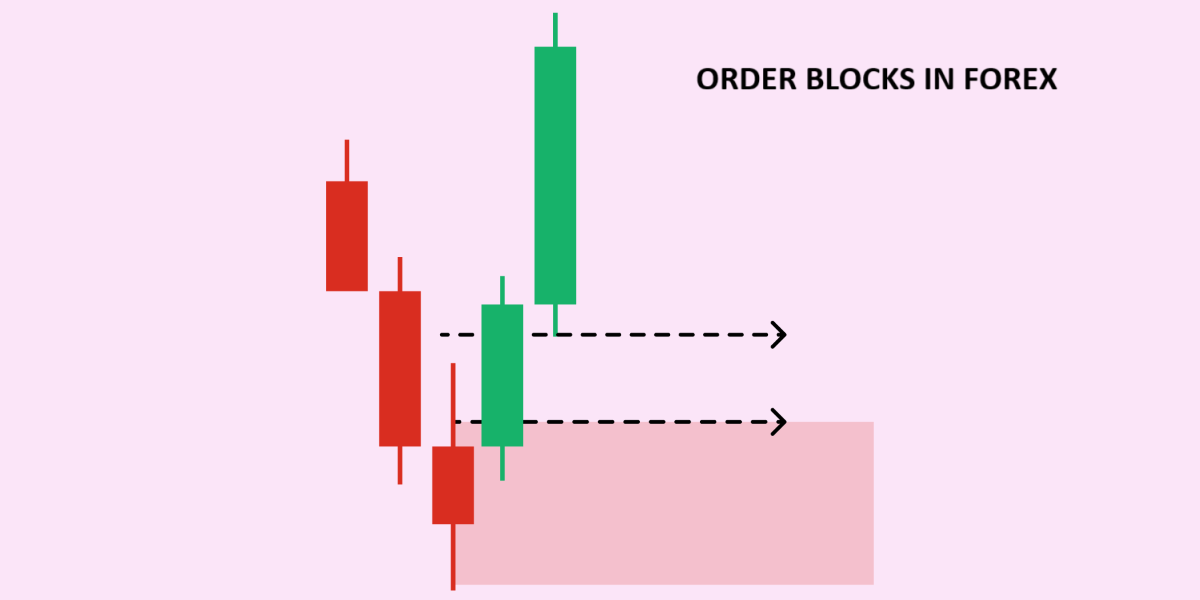

Understanding How the Big Players Move the Market
If you’re new to forex trading, you’ve likely come across terms like “support and resistance,” “liquidity zones,” or “smart money.” But one term that might not be as common – yet is incredibly powerful – is order blocks.
In this article, we’ll explain what order blocks are, why they matter, how to spot them, and how you can use them to your advantage in the forex market.
What Are Order Blocks in Forex?
An order block is a price area where large financial institutions – think banks, hedge funds, and even central banks – place significant orders to buy or sell currency pairs. These aren’t your everyday retail trades. They’re massive trades, so big that placing them all at once would drastically shift the market.
To avoid this disruption, institutions break down their trades into smaller chunks. These chunks are grouped and executed over time, usually within a specific price zone. This zone, often visible on a chart as a tight price range with increased volume, is what we call an order block.
Why is this important for retail traders like you? Because institutions tend to have better data, deeper analysis, and more experience – and when you spot an order block, you’re potentially seeing where the “smart money” is moving.
Why Do Order Blocks Matter?
Understanding order blocks gives you a peek into institutional trading strategies. Here’s why they matter:
-
They indicate key price levels – Order blocks often act as support and resistance zones.
-
They precede large market moves – Many strong trends begin with a breakout from an order block.
-
They show market intent – Big traders rarely guess. Their activity often reflects high-conviction trades.
-
They can help you avoid fakeouts – Recognising these zones can stop you entering trades at the wrong time.
How to Identify an Order Block
Here’s how you can begin spotting order blocks on your chart:
1. Look for Ranging or Consolidating Markets
Order blocks are typically found in price consolidation zones just before big moves. These zones will often show multiple candles with similar highs or lows.
2. Use Volume Indicators
Indicators like the On-Balance Volume (OBV) or Klinger Oscillator can help confirm if the cluster has high volume — a potential sign that large orders are being executed.
3. Watch for Breakouts
A clear price break above or below a consolidation zone often signals the conclusion of an order block and the beginning of a new trend.
4. Verify with Support and Resistance
Most order blocks align with key levels of support or resistance. Confirmation from other tools, like trendlines or Fibonacci levels, can strengthen your analysis.
Order Block Trading Strategies
Once you’ve identified an order block, you can start incorporating it into your strategy. Here are a few beginner-friendly approaches:
Trade the Breakout
Wait for price to break out of the order block zone. Enter when there’s confirmation of trend direction (e.g. bullish candle close above the zone). Set your stop-loss just below or above the opposite side of the block.
Ride the Retest
After a breakout, the market often retests the block before continuing its move. Enter at the retest with a tighter stop-loss and a defined target.
Use Them as Support/Resistance Zones
Order blocks act like invisible barriers. If price approaches an order block from above, it may act as support; from below, as resistance. Trade accordingly using bounce setups.
Tips for Trading Order Blocks Safely
-
Use confirmation tools: Always combine order blocks with other indicators (moving averages, RSI, etc.).
-
Don’t assume every consolidation is an order block: Look for volume spikes and institutional behaviour clues.
-
Be patient: Good order block setups don’t happen every day. Quality over quantity wins in trading.
-
Practice risk management: Only risk 1–2% of your capital per trade.
Order Blocks vs. Regular Support and Resistance
|
Feature |
Order Blocks |
Support/Resistance |
|
Origin |
Institutional trades |
Repeated price interaction |
|
Volume |
Typically higher |
Varies |
|
Frequency |
Rarer |
Common |
|
Signal Strength |
Stronger when confirmed |
Depends on market context |
Final Thoughts
Understanding what order blocks are in forex and how they work can transform your trading game. They offer valuable insight into what institutional traders are doing and allow you to ride on the coattails of smart money.
Whether you’re just starting or looking to refine your edge, using order blocks gives you more control and context in the chaotic world of trading.
